
Control Is Costing You Growth
“Control feels safe, but it quietly limits how far your business can go.”
— Helena Klassen
For many business owners, control feels responsible.
You stay involved because you care about quality.
You review everything because you want consistency.
You oversee every detail because you believe nobody understands the business the way you do.
At first, this mindset can help a business survive.
But eventually, the same habit that helped build the business begins limiting its ability to grow.
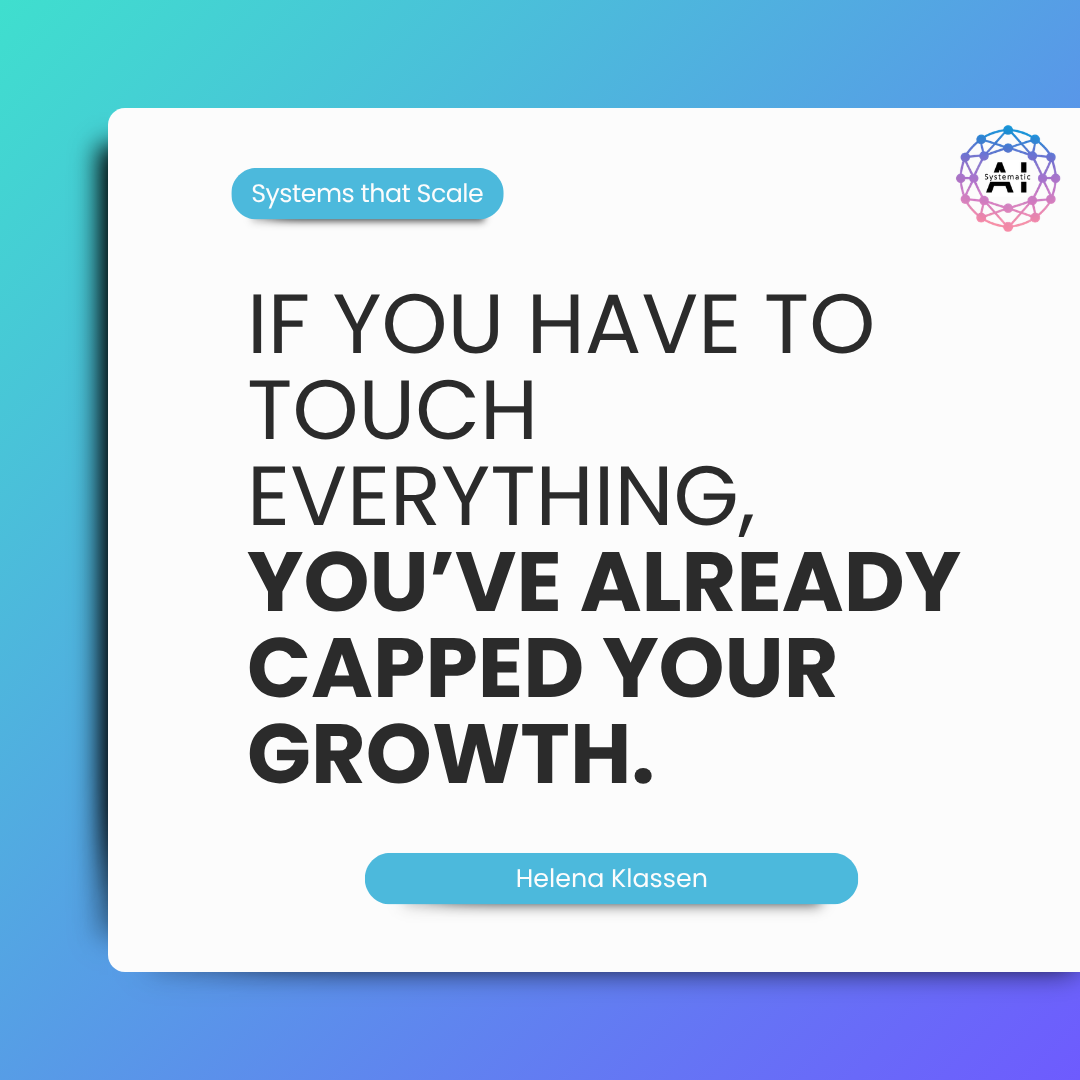
Growth begins the moment your business stops relying on you for everything.
Because the more your business depends entirely on you, the more growth becomes restricted by your personal capacity.
And that is where many founders unknowingly hit a ceiling.
The Hidden Cost of Control
Control rarely feels dangerous in the beginning.
In fact, it often feels productive.
You answer the emails.
You approve the work.
You manage the operations.
You fix problems quickly.
You stay involved in every decision.
Things move because you push them forward personally.
But over time, this creates a business structure where nothing moves efficiently without your direct involvement.
The founder becomes:
• The decision maker
• The approval system
• The problem solver
• The operations manager
• The backup plan for everything
Eventually, growth slows not because the business lacks opportunity, but because too much responsibility flows through one person.
This is one of the most common scalability problems modern businesses face.
As leadership expert Craig Groeschel once said, “If you delegate tasks, you create followers. If you delegate authority, you create leaders.”
Many businesses never reach that second level.
Why Founders Hold On Too Long
Most entrepreneurs do not struggle with control because they are incapable of trusting people.
They struggle because letting go feels uncomfortable.
Several patterns often drive this behavior.
Fear of Mistakes
Founders often believe it is faster or safer to handle work themselves.
Teaching someone else feels slower in the moment.
But constantly redoing work personally creates long term dependency.
Identity Attachment
For some business owners, being deeply involved becomes part of their identity.
They become known as the person who handles everything.
Stepping back can feel unfamiliar or even uncomfortable.
Lack of Systems
Control increases when systems are weak.
If processes only exist in your head, delegation feels risky because consistency depends entirely on memory and oversight.
Perfectionism
Many founders unintentionally confuse high standards with total control.
But scalable businesses are not built through constant founder involvement.
They are built through repeatable systems and clear accountability.
Control Creates Bottlenecks
Every business eventually reaches operational limits.
The question is whether the business grows through systems or stalls through dependency.
When founders control too much:
• Teams hesitate to make decisions
• Projects move slower
• Communication becomes delayed
• Execution depends on approvals
• Innovation decreases
• Burnout increases
The founder becomes the bottleneck without realizing it.
And bottlenecks create invisible friction across the entire business.
Entrepreneur and investor Naval Ravikant once explained that leverage is what allows businesses to grow beyond individual effort.
Without leverage, growth remains tied to personal output.
The Difference Between Leadership and Control
Strong leadership is not about overseeing every detail.
It is about creating clarity, direction, and systems that allow people to execute effectively without constant supervision.
Control focuses on involvement.
Leadership focuses on enablement.
These are very different mindsets.
A controlled business depends heavily on the founder.
A scalable business depends on systems, communication, and ownership.
That transition is uncomfortable for many founders because it requires trust, structure, and operational discipline.
But without it, growth eventually plateaus.
What Sustainable Growth Actually Requires
If you want a business that scales consistently, the goal is not to control more.
The goal is to build a structure that functions effectively without requiring your constant presence.
That requires several important shifts.
1. Move From Approval to Accountability
Instead of reviewing every small detail, create clear ownership.
People perform better when expectations are defined clearly.
That includes:
• Defined responsibilities
• Clear outcomes
• Communication systems
• Performance standards
Accountability creates consistency without requiring micromanagement.
2. Build Repeatable Processes
You cannot scale confusion.
Document workflows that repeat regularly:
• Client onboarding
• Customer communication
• Internal operations
• Marketing tasks
• Administrative procedures
Strong systems reduce errors while increasing operational independence.
3. Delegate Outcomes, Not Just Tasks
Many founders stay trapped because they only delegate small tasks while retaining all real decision making.
Real growth happens when ownership expands.
Instead of assigning isolated activities, assign clear outcomes and responsibilities.
This creates momentum without constant oversight.
4. Strengthen Operational Support
This is one reason virtual assistance and operational support have become essential for growing businesses.
A strong support structure can handle:
• Scheduling
• Inbox management
• Customer follow ups
• Data organization
• Administrative work
• Social media coordination
• Workflow tracking
The goal is not simply removing tasks.
The goal is reducing operational dependency on the founder.
That creates space for strategic thinking, leadership, and sustainable growth.
Growth Requires Letting Go
One of the biggest mindset shifts founders face is understanding this:
Being involved in everything does not make the business stronger.
In many cases, it makes the business more fragile.
Because if operations slow down every time the founder steps away, the business has not truly become scalable.
It has simply become founder dependent.
That dependence eventually limits:
• Capacity
• Revenue growth
• Team performance
• Innovation
• Long term sustainability
Control may feel safe in the short term.
But over time, it quietly becomes expensive.
A Smarter Definition of Control
Ironically, the founders who scale successfully do not lose control.
They redefine it.
Instead of controlling every task, they control:
• Systems
• Standards
• Vision
• Accountability
• Operational structure
That creates consistency without creating dependency.
And that is a far more sustainable way to grow.
Entrepreneur Michael Hyatt summarized this idea clearly: “Your business will never grow beyond your ability to delegate.”
That truth becomes more obvious at every stage of growth.
The Perspective Shift
Instead of asking:
“How do I stay involved in everything?”
Start asking:
“How do I build a business that operates effectively without needing me everywhere?”
That shift changes how businesses scale.
Because growth does not come from founder control.
It comes from operational clarity, delegation, and systems strong enough to support expansion.
And the businesses that grow sustainably are rarely the ones where one person controls everything.
They are the ones built to function beyond one person’s capacity.
If you’re ready to stop carrying every operational responsibility yourself, grab our free guide: The 6 Proven Marketing Systems That Drive 25% Growth.
Or join our on demand webinar to learn how smarter systems create more freedom, consistency, and scalable growth.
